


Natural Draft Cooling Towers
Our natural draft wet cooling towers have been used to cool water, primarily in energy production, for almost 100 years. The tower operates on the stack effect which causes the hot air in the tower to rise (natural draft).. The necessary stack can be designed in various ways. For both technical and cost reasons, reinforced concrete structures have become standard to handle the high cooling water flow rates from increasingly large power generating units. We have, in the last 50 years, designed natural draft cooling towers for a variety of applications with the world's tallest being the 202 M iconic cooling tower located at kalisind for a twin 660 MW thermal power station in Rajasthan, India
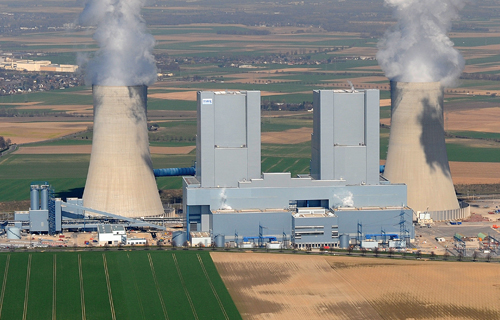 Natural Draft Cooling Towers (RWE power plant in Neurath, Germany)
Source: RWE
Areas of application
For large power plants and industries with unlimited cooling water flow. The largest cooling water flow in a single natural draft cooling tower designed by us in India till date has a flow rate of 84,000 m³/h.
Key features
The required air stream volume for cooling is exclusively produced by the stack effect. The unique economic advantage of natural draft cooling towers lies in their extremely low electric energy requirement. The operating costs are minimal.
Economical for high cooling loads and depreciation over a long period.
The great distance between the air inlet and the air outlet of the cooling tower dependably avoids any recirculation of warm air that could lead to reduced performance.
The almost complete lack of moving parts allows for high operating reliability and minimal maintenance requirements.
The height of warm air outlet point allows the surrounding area to remain untroubled by the effects of cooling system.
Cold water temperature in comparison to cell cooling towers
The cooling air flow volume from natural draft cooling towers is directly dependant on local conditions like air temperature, relative humidity and barometric pressure. In mechanical draft cooling towers, the air volume stream is created by fans and remain constant. Thus , varying local conditions create varying cool tower characteristics. Below the design point, a natural draft cooling tower offers more favorable cold water temperatures than a cell cooling tower and vice versa.
Winter operation of a natural draft cooling tower
In contrast to a mechanical draft cooling tower, the cooling air stream volume in a natural draft cooling tower is not directly controllable. For winter operation, depending on the outside temperature and thermal load, the following control elements can be deployed: zone control, i.e. disconnecting individual cooling zones and winter control, i.e. creating an air inlet hot water curtain bypass
Winter operation
The water distribution system is constructed for approx. 120% overload. In the case of isolated cool zones, the excess water is diverted through the bypass directly in to the cold water basin. This process uses no fittings and the diversion takes place hydraulically. The start-up in winter poses no problems.